what is transitional living?

Choice House’s transitional living is built on a campus of 14 individual homes in Louisville, Colorado. Each client with their own bedroom, full clinical support integrated throughout, and a community of 30 to 40 men practicing recovery together. The guardrails are real, the expectations are high, and the freedom to build a life increases as men earn it.

choice boulder hike

building the foundation

The mission of Choice House is to develop an unshakable foundation for our men and their families who entrust us with their care. When a family understands what that truly requires, trusts the process enough to step back, and their loved one has even just a small amount of willingness, we often succeed in that mission.

More often than not, the men who complete our program don’t go home, they stay. Boulder becomes their city. The community they built here becomes the one they choose to live inside, a place they’re proud to be. Hobbies that bring joy and friendships forged in vulnerability that create bonds most people never find. Close to a year sober. Rebuilt relationships with family that were utterly fractured. A morning routine that doesn’t begin with managing withdrawal or planning the first drink. The ability to feel something uncomfortable and stay in the room with it.

We want to return to the world a man who knows who he is, shows up for the people he loves, and has a community around him that will answer the phone at 2am. A man his family recognizes again, maybe for the first time in years.

How do we get there?

Structured Community

Our transitional living campus spans 14 homes and 43 individual bedrooms across a tight-knit Louisville neighborhood. Every client has their own room, and the density of the community makes isolation nearly impossible. With 30 to 40 men living within walking distance of each other, there is always something happening. The group chat alone tells the story: golf, hikes, ski days, pickup games, gym sessions, spontaneous cookouts. Staff facilitate early on, but the expectation is that the community increasingly drives its own culture.

Structure is built into every week. On Monday morning, our IOP group starts the week with intention. Groups on Tuesday and Thursday evenings bring that cohort back together. Wednesday evening is a barbecue and open 12-step meeting led by clients themselves. Sunday is a full community meeting where everyone comes together. From minor maintenance issues to the overall spirit of the campus, nothing is off the table. Four 12-step meetings weekly are required, and sponsorship is an expectation, not a suggestion.

Clinical care is fully integrated into Phase II from day one. Our intensive outpatient program runs 9 hours of group therapy weekly, stepping down to 3 after a few months as clients build stability and independence. Individual sessions with a therapist, case manager, and our program director are woven into the week, ensuring that each man has consistent eyes on where he is and what he needs. Until a client is employed or enrolled in school, mornings begin with H.E.R.D. meetings — structured time that builds the executive functioning, accountability, and daily discipline that a productive life requires. Weekly psychiatric and medical appointments are available to all clients who need support in those areas.

Our Director of Outdoor Activities, Shawn Krush, leads outdoor outings in the early weeks of Phase II — getting men moving, outside, and connected to the community as they integrate into it.

choice house alumni

our campus

Map Legend e1781531863119
charlesdeluvio rRWiVQzLm7k unsplash

mental health support during transitional living

For most of the men who come to Choice House, addiction and mental health are inseparable. Anxiety, depression, trauma responses, mood disorders; these don’t resolve at discharge from residential. Phase II is built with that reality in mind. Our director, case managers, and behavioral techs are on campus daily, providing consistent presence and relationship for men who are still stabilizing emotionally and psychologically. Clinical and administrative staff are woven into the program throughout the week, and weekly psychiatric and medical appointments are available to every client who needs them.

What shifts in Phase II is not the level of support but the expectation. The men in our care are asked to begin meeting their own mental health needs proactively. To recognize when they’re struggling. To reach out before things escalate. To ask for help. To practice the emotional regulation, distress tolerance, and self-awareness that residential care introduced and life demands. Case managers work alongside clients on the practical infrastructure of a stable life. Employment, finances, relationships, legal obligations, etc. Because stability in those areas is inseparable from mental health.

The goal isn’t just sobriety. It’s a man who knows and manages himself. A man who is regulated, is interested in giving back and kind. A man who no longer needs to escape.

A minimum 120-day commitment is required, though length of stay is tailored to where each client is in his recovery.

recovering outdoors

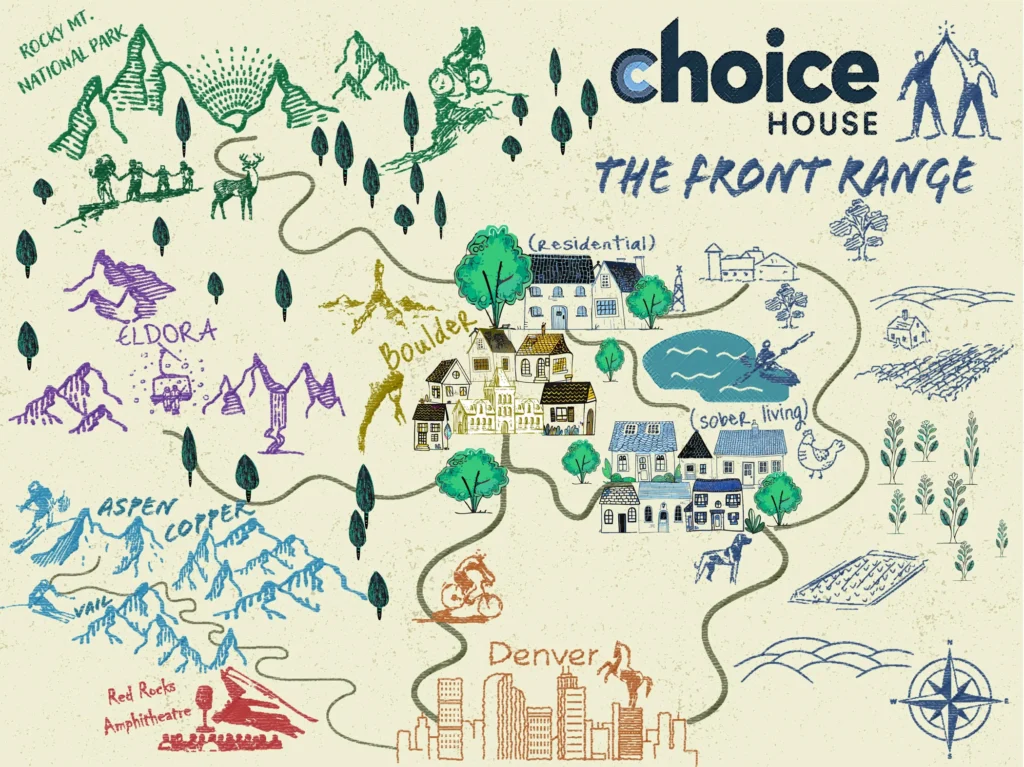
Boulder, Colorado is not a backdrop, it’s part of the treatment. The Flatiron Mountains, Chautauqua Park, hundreds of miles of trails, ski resorts a short drive away, rivers, open space, a city and its culture built around being outside. We chose this location deliberately, because we believe that getting outside is a powerful way to heal what’s inside. Nature has a way of regulating the nervous system, quieting the noise, and reminding a person that the world is bigger than their problems.

Shawn Krush, our Director of Outdoor Activities, gets new clients moving from the beginning. Hikes, ski days, outdoor excursions that introduce men to the landscape and to each other before they’ve fully found their footing. But the culture doesn’t depend on staff to sustain it. By the time a man has been here a few weeks, he’s been invited on more adventures than he can keep up with. Golf, skiing, climbing, fishing, trail runs, spontaneous trips into the mountains.  The group chat among 30 to 40 men is a constant stream of plans being made and invitations being extended.

That culture starts in residential and carries forward. Men who came in isolated and avoidant leave with a genuine relationship with the outdoors and a community of people who share it. Getting outside becomes less of an activity and more of a lifestyle. A lifestyle that doesn’t require a substance to access.

Choice House - Illustrated Map - Rehab grounds in Colorado